Knives

Gyuto
This is the Japanese interpretation of the Western chef knife. Gyuto translates as "cow blade" having been originally designed to cut large pieces of meat. It was inspired by the knives being used by English & French chefs. It has a steeper curve along the cutting edge that most traditional Japanese blades. This profile allows for more western style of cutting including rock chopping. It is an incredibly versatile knife, now a favourite amongst professional & experienced chefs worldwide. Blade lengths are usually 8 inches or longer.
-
7.75" / 195mm Gyuto Dark Mai 80CRV2 Lamtoro Burl
Regular price £395.00 GBPRegular priceUnit price per -
8" Gyuto CPM-20CV Maple Burl (Faceted)
Regular price £365.00 GBPRegular priceUnit price per -
8" / 205mm Gyuto AEB-L Roasted Curly Ash
Regular price £275.00 GBPRegular priceUnit price per


Bunka
The Bunka is the predecessor to the Santoku with more traditional Japanese roots. The name Bunka means “culture” as the knife got its name from being used to create traditional Japanese cuisine. The cutting edge is generally flatter than that of the Santoku making it more suitable to push and pull cuts. The distinctive “K-tip” gives it a recognisable shape and helps separate it from the Santoku. Like the Santoku it is designed be used for a variety of foods including meat, fish & veg.
-
6.75" / 170mm Bunka Damascus Cu Mai Apex Ultra Mun Ebony & Buffalo Horn
Regular price £445.00 GBPRegular priceUnit price per -
6.5" / 165mm Bunka Dark Mai 80CRV2 Ebony & Elforyn Supertusk
Regular price £395.00 GBPRegular priceUnit price per -
7" / 175mm Bunka Dark Mai 80CRV2 Desert Ironwood Burl & Buffalo Horn
Regular price £445.00 GBPRegular priceUnit price per -
7" / 175mm Bunka Dark Mai 80CRV2 Moon Ebony & Buffalo Horn
Regular price £395.00 GBPRegular priceUnit price per


Santoku
The Santoku has become the most popular knife used by home chefs in Japan. The name Santoku translated to ‘three virtues” which is believed to refer to the ingredients it can be used for fish/meat/veg. The “Sheepsfoot”profile towards the tip gives it a very recognisable shape. The flatter heel shares some of the characteristics of the Nakiri, making this section of the knife ideal for cutting vegetables. This allows for more contact with the chopping board and the raised tip makes it possible to perform rock chops.
-
7" / 170mm Santoku AEB-L Crazy Micarta Mystic Timber
Regular price £265.00 GBPRegular priceUnit price per -
6.5" / 165mm Santoku Damascus San Mai Apex Ultra - Spalted Guava & Buffalo horn
Regular price £445.00 GBPRegular priceUnit price per -
 Sold out
6" Santoku AEB-L Green Maple Burl
Regular price £245.00 GBPRegular priceUnit price per -
7" Santoku AEB-L Mirror-stonewash Spalted Burl Red
Regular price £265.00 GBPRegular priceUnit price per


Petty
The name Petty comes from the French “petit” meaning small. Petty has become a term used to refer to a variety of utility knifes on the smaller side. Traditionally taking influence from the larger French style chef knives. The very classic slender versions work well for hand-held cutting. The cutting edge is generally a long sweeping curve, closer in profile to western knives or a miniature Gyuto. Petty blades usually measure somewhere between 4.5 and 6 inches.
-
5" / 125mm Petty AEB-L Crazy Micarta Mystic Timber
Regular price £225.00 GBPRegular priceUnit price per -
4.5" / 115mm Petty AEB-L Crazy Micarta Red & Black
Regular price £195.00 GBPRegular priceUnit price per -
5" / 125mm Petty AEB-L Curly Mango & Green G10
Regular price £225.00 GBPRegular priceUnit price per -
6" / 150mm Petty Cu Mai 80CRV2 & Snakewood
Regular price £365.00 GBPRegular priceUnit price per


Paring
Paring knives get their name from the word “pare”, meaning to peel or remove the outer surface. This specific task requires quite a different profile and size to the larger general-purpose knives. Being that most peeling is done in-hand there is little need for proper knuckle clearance on a chopping board. This makes a small and slender blade well suited to this purpose. The edge is usually straighter than a petty making it ideal for precise cuts.
-
73mm / 3" Paring Damasteel Richlite Tanglewood
Regular price £225.00 GBPRegular priceUnit price per -
65mm / 2.5" Paring Dark Mai 80CRV2 Richlite Luna
Regular price £145.00 GBPRegular priceUnit price per -
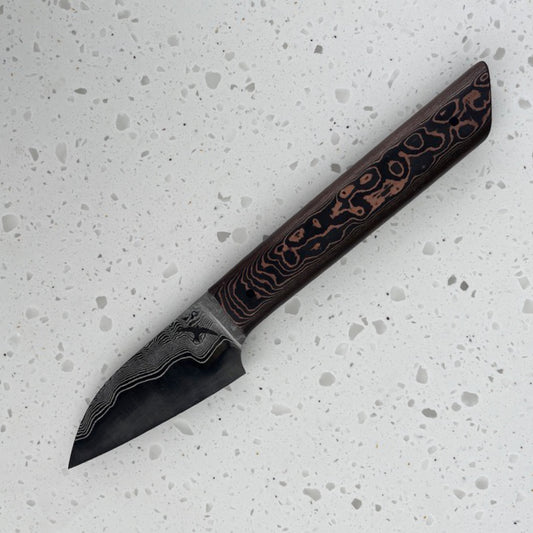
2.5" Paring Damascus San Mai Fatcarbon Copper Camo
Regular price £195.00 GBPRegular priceUnit price per -
70mm / 3" Paring Damascus San Mai 80CRV2 Richlite Eldorado
Regular price £175.00 GBPRegular priceUnit price per